


UISEE AI Driver Powers HKIA — World's First Large-Scale Airport Autonomous Vehicle Operations Pioneer
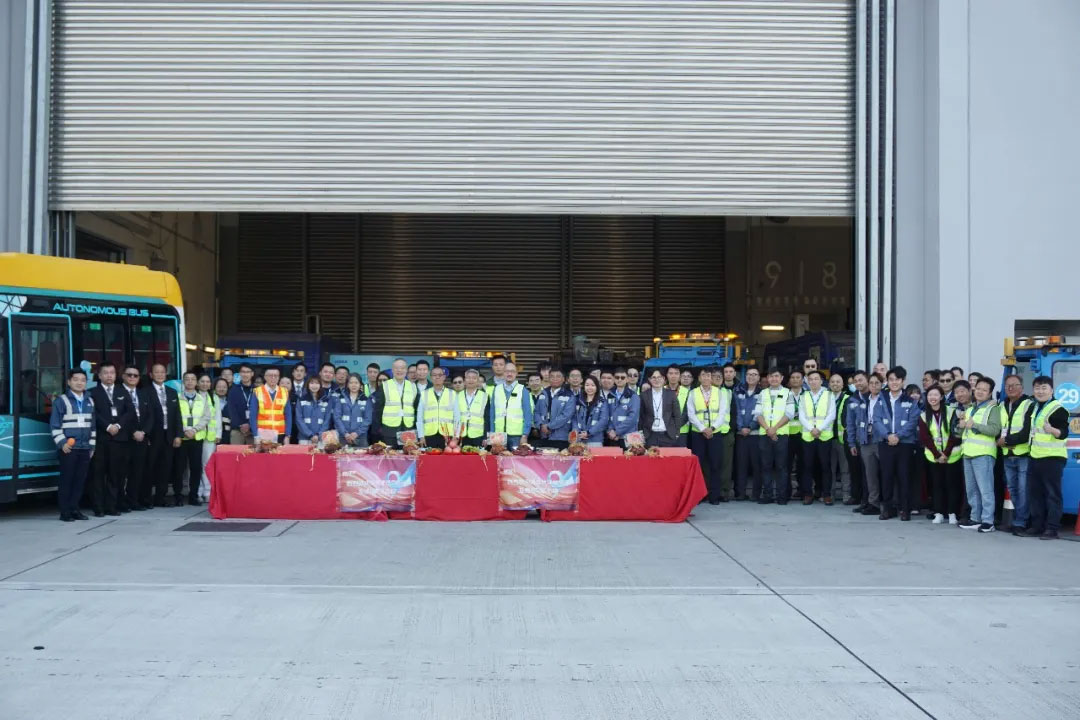
At the start of 2026, UISEE held a traditional Chinese "roast pig cutting" ceremony at Hong Kong International Airport (HKIA) — a festive Lunar New Year custom — to express sincere gratitude to the Airport Authority Hong Kong (AAHK) for their long-term trust and strong support in airport autonomous driving operations.The ceremony was filled with joy and prosperity. The UISEE Hong Kong team and key executives from AAHK gathered together in the auspicious atmosphere of the Year of the Horse Spring Festival, jointly witnessing this moment that carries both traditional significance and innovative milestone meaning.
.jpg)
After nine years of deep collaborative innovation, UISEE has helped Hong Kong International Airport become the world's first airport to achieve large-scale deployment of autonomous vehicles in actual airport operations. With trusted L4 autonomous driving technology, UISEE has helped HKIA revolutionize both airside and landside operations, while reshaping operational efficiency and workforce models, and bringing new transformation to future passenger travel experiences.
Seven years ago, UISEE was the first to deploy autonomous vehicle technology at scale at HKIA, becoming a true industry pioneer. Today, as airports worldwide begin adopting autonomous vehicles, the benchmarks and standards UISEE set at HKIA have been referenced and applied by airports across the globe.
.jpg)
At HKIA, each Autonomous Electric Tractor on average saves 4 human driver positions. With 56 Autonomous Electric Tractors in operation, the airport saves over 200 drivers' worth of labor costs. More importantly, the AI Driver does not simply replace human driving — it enables the airport to redeploy more technical staff to the control center, while also cultivating talent in technical expertise, management, and software development.
Currently, UISEE operates over 70 autonomous vehicles at HKIA, including more than 56 Autonomous Electric Tractors, 8 autonomous patrol vehicles, and 6 autonomous shuttle buses. The autonomous fleet has accumulated over 4 million kilometers of driving, achieved over 1,500 days of normalized operations, and efficiently safeguards over 300 flights per day — perfectly meeting HKIA's demanding standards for high density, high timeliness, and high safety.
UISEE's AI Driver has also made HKIA the world's first airport to deploy L4 autonomous driving technology across all autonomous vehicles. The fleet operates completely free of human intervention within designated environments, marking a leapfrogging development compared to L3 autonomous driving technology that requires constant human monitoring.
Autonomous Electric Tractor
.jpg)
UISEE's autonomous driving journey at HKIA began in 2019, when UISEE first applied Autonomous Electric Tractors to airport baggage transport.
Inside the baggage hall, Autonomous Electric Tractors follow instructions to tow multiple baggage trailers along three preset routes, each ranging from 2.7 to 3.5 kilometers. The vehicles are equipped with high-performance LiDAR, differential GPS, collision avoidance sensors, and trailer monitoring cameras — enabling seamless parallel operations with other vehicles driven by airport staff. In addition to obstacle avoidance and overload detection, the tractors can also autonomously switch between fast and slow lanes inside tunnels or designated road sections, minimizing the impact of temporary road closures on airport operations.
When the tractor arrives at the safe zone near the aircraft stand, it can automatically release the towed baggage trailers without human intervention, then independently return to the designated handover area to await the next task.
Currently, Autonomous Electric Tractors have also been upgraded with automatic charging robotic arms for self-charging. The precision positioning operations and point-to-point transport model of Autonomous Electric Tractors have significantly improved airport operational efficiency. In the future, their application scope will be further expanded to the airport's cargo terminal and other operational areas.
Autonomous Patrol Vehicle
.jpg)
Another key member of the airport autonomous fleet is the autonomous patrol vehicle, which performs patrol duties in the perimeter areas of the airport airside under all weather conditions. The patrol vehicle can automatically detect potential intruders within 3 meters of the security fence and immediately alert the airport's Integrated Control Center. It can also identify abnormal conditions on apron roads — particularly damage to razor-wire fencing — and promptly report the situation to the control center.
Autonomous Shuttle Bus
.jpg)
Since 2023, a fleet of highly secure and intelligent autonomous shuttle buses has been operating in the airport restricted zone, providing commute services for staff traveling between the apron and more than 20 work locations. These 6 buses operate on 3 designated routes, each ranging from 2.8 to 5.5 kilometers.Like other members of the autonomous fleet, the autonomous shuttle buses are equipped with a top-tier technology system, integrating high performance, high precision, and high intelligence to provide passengers with a smooth and reliable riding experience, creating a safe, smart, and connected travel environment for airport employees.
Recently, HKIA announced it will officially open the new passenger departure facilities at Terminal 2 on May 27, 2026, bringing passengers a more comfortable and convenient new experience during the peak summer travel season.、
Facing the upcoming increase in passenger traffic, UISEE will continue to upgrade its autonomous driving safety foundation, comprehensively enhance safety features, and ensure stable all-weather operations across all projects. Together with HKIA, UISEE looks forward to embarking on a new journey of airport digital and intelligent transformation, helping HKIA solidify its position as a world-class smart aviation hub.
Follow UISEE on social media: